THE 10 SPOKE PAGE
Revised 10/1/21
Today 10 spoke wheels are very popular on 1968 Shelbys. There have been many variations of the wheel.
The Shelby Wheel Company (separate from Shelby Automotive) continued to make the wheel after 1970.
Not many cars received factory
10 spoke wheels. Only three 1968s have been documented leaving the factory with 10 spoke wheels.
It's probably approriate to call these wheels "1967 ten spokes". All 1967 style ten spoke wheels are 15 x 7.
I spoke with one original owner about 10 spoke wheels. Dan purchased a new GT500 KR in the summer of 1968.
He told me, 10 spokes were not available from the dealership.
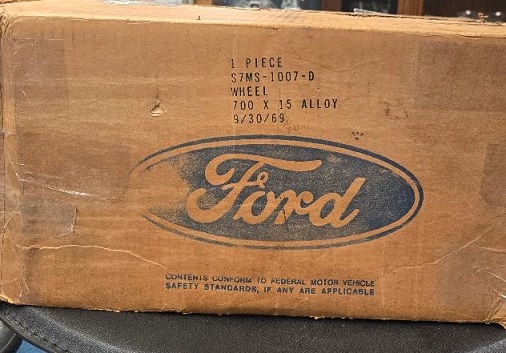
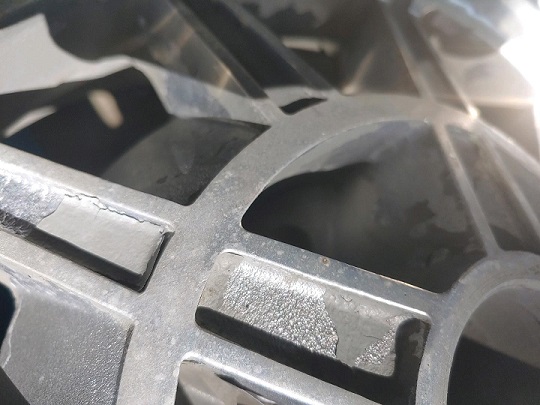
Here are Dan's wheels. Of particular
note are the 1969 date codes on the
original boxes. These wheels were also painted in the cast areas.
I have installed 10 spokes on several cars. Often times there are clearance problems with disc brake
calipers on 1968s. The calipers can be modified to accept the wheels with some grinding.
We can look at a number of features to identify these wheels. The first is the spoke design.
Tapered spokes are more narrow on the rim and wider at the center of the wheel.
The next thing to look at is the position of the valve stem.
Finally, the type of lug nut used will determine how the mounting holes are drilled in the wheel.
The Best 10 spoke Wheel Chart
| Wheel |
Spoke Design |
Valve Stem Location |
Lug Nut hole design |
Notes |
| version 1 |
tapered |
on rim |
countersunk |
1967 version w/ Part No. *
Rough cast on backside |
| version 2 |
tapered |
on rim |
countersunk |
w/raised area on back of wheel / 1969 version |
| version 3 |
tapered |
between spokes |
countersunk | CS Wheel Co / 1970s version |
| version 4 |
tapered |
on rim | flat face |
CS Wheel Co / Branda / Mid- 1980s version |
| version 5 |
tapered |
between spokes | flat face |
CS Wheel Co / Branda / Early 1990s version |
| version 6 |
straight |
on rim | flat face |
CS Wheel Co / Branda / Mid 1990s |
| version 7 |
straight |
on rim | countersunk |
CS Wheel Co / Branda / Circa 2010 |
| version 8 |
tapered |
on rim | countersunk |
Legendary Wheel (Chinese) / Circa 2020 |

This wheel is listed on the chart above as "version 1". *Note: Some of these early wheels may have been produced without part numbers on back.
The spokes have a slight taper to them and the valve stem is on the rim. The holes for the lug nuts are countersunk. This wheel matches some early 1968 press photographs. The wheel has a "57MS-1007-D" part number cast into the back. Other wheels may also have this casting.

This wheel is Version 2. It is also a "period correct" wheel. The raised area is a revision (on the back of wheel).
There is a second version of the original (Version 1) wheel. It has no raised area on the backside, it also has no part number casting. The other features are the same.

This wheel is listed on the chart above as "version 4.
The spokes have a slight taper to them and the valve stem is on the rim. The holes for the lug nuts have a flat surface.

This wheel is listed on the chart above as "version 5".
The spokes have a slight taper to them and the valve stem is between the spokes. The holes for the lug nuts are flat. The lug nut uses a washer behind it.

This wheel is listed on the chart above as "version 6".
The spokes are straight and the valve stem is on the rim. The holes for the lug nuts flat.
I believe this wheel is from the 1980s.
I will post other pictures as they become available.
WARNING: Do not mix lug nuts. If your wheel has a flat surface for the lug nut hole,
only use a lug with a corresponding flat bottom.
If you have a wheel design not listed in the chart, please let me know. A picture would be helpful.
Back to SUSPENSION