La voiture d'exposition de Paris
juste à temps
1/14/2011
A special thanks to my friends in France that assisted with this article.
The 1968 Paris Show Car-
Just in time
For the past the couple of years, I have been pursuing information on the very early 1968 Shelbys. One interesting
car has been on my list. It was a vehicle referenced
on a piece of factory paperwork as the "Paris Show Car". I now believe there may have been
as many as ten cars built before regular production of 1968
Shelbys started in late November of 1967. These cars were used for crash tests, prototyping and various promotional purposes.
These pre-production or "pilot" cars also had a series of unique
physical features.
In the summer of 1967 the GT40 had scored its second consecutive win at LeMans. Ford of France was eager to display the new 1968 Shelby Mustangs. A series of telegrams detailed
the request for
a new GT500 to be displayed at the "Salon de L' Automobile". These records also show a GT350 was substituted as a last minute replacement.
This car was delivered to Orly International Airport (near Paris, France) on September 30, 1967.
The GT350 arrived just days before the opening of the show. "Juste à temps" as they say in France.
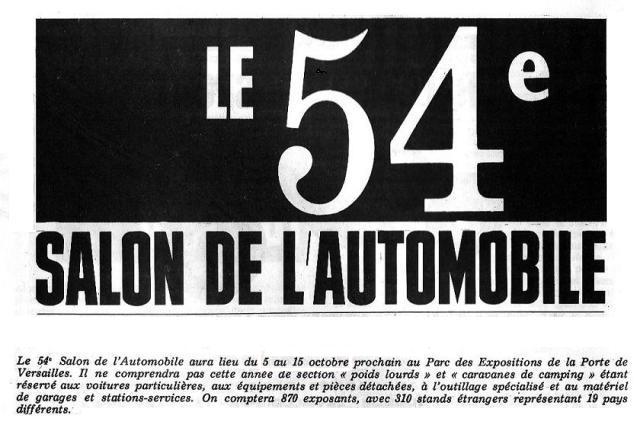
The 54th Paris Auto Show was held October 5-15th, 1967.
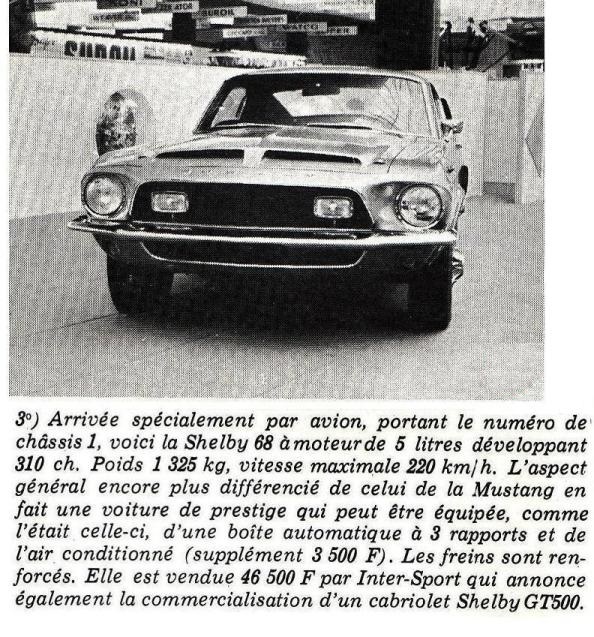
This article was found on French car forum (www.autodiva.fr). It is dated November 1967, a couple of weeks after the Paris Auto Show. The English
translation tells us everything
we need to know about a car described as "chassis one":
Arriving specially by plane, carrying the chassis number 1, this 1968 Shelby has a motor of 5 liters ( 302 )
developing 310 Horsepower, weighing 1.325 kg ( 2920 lbs ), maximum speed 220 km/h ( 137 mph )
The general features even more differentiate it from that of a Mustang, in fact, a car with prestige, that
can be equipped like this one, has the automatic transmission and air conditioning (additional $ 639 USD) the
brakes are reinforced. It sells for $ 46 500 Francs ( $8485.00 US Dollars in 1968) by Inter-Sport, which
also announces marketing a convertible Shelby GT500.
The US base retail price for a GT350 fastback was $4117.00
What's interesting is the car is described as "chassis 1". The 1968 Shelby with serial number 00001 has been located and it does not appear to be the same car.
According to the information recently uncovered the
car serialized as number one was a 4 speed car without air conditioning. That car was built after September of 1967. So which car is this?
According to my information only four cars were built before this show. Only one was a GT350 fastback and that was # 8T02J110578-00339.
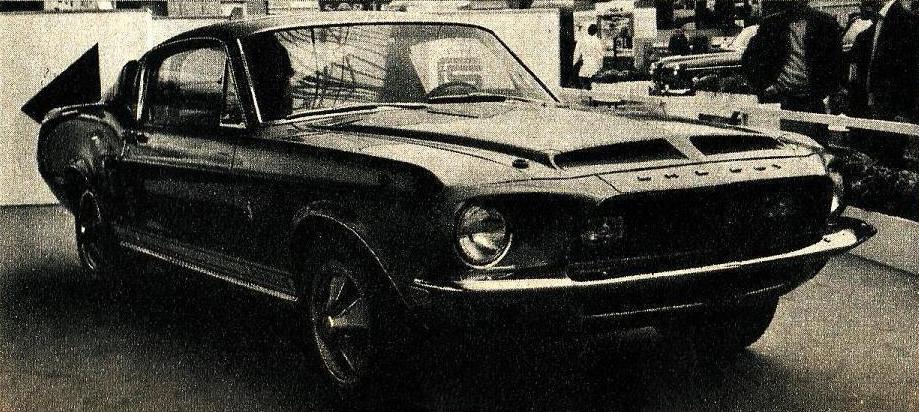
This picture reveals some never before seen details of an early car, like lanyards on the hood pin fastners.
It was previously thought early cars had rocker stripes similar to the 1967s. However, these are clearly 1968 rocker
stripes.
The Shelby American Automobile Club collects information on all Shelbys and is currently in the process
of publishing a new World Registry describing the history of these cars. For more information contact the club directly.
Hopefully, the history of the "Paris Show Car" will soon be added to the new Registry. . . juste à temps, as they say in France.
1968 Paris Show Car Found?
Updated January 1, 2026
Special Thank you to Joel in France, John and Wolfgang!
In the fall of 1967, a handful of "pre-production" Shelbys were built. One
of these cars, a fastback, was shipped to France for the annual Auto Show. Originally, Ford of France asked for a GT500,
but a GT350 was substituted at the last minute. We know the the car was Sunlit Gold. It had an automatic transmission and air conditioning.
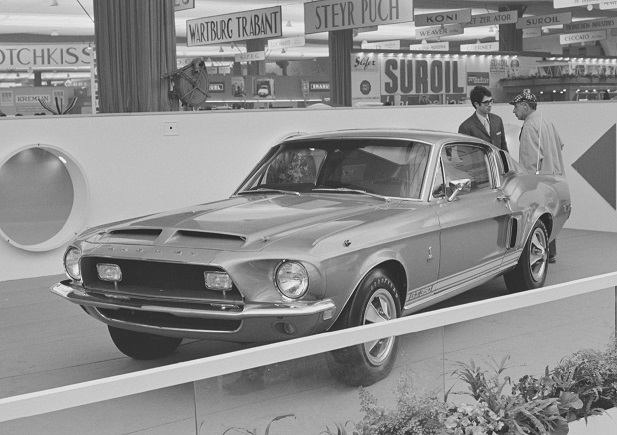
One of the most noticeable additions to the car were the fender mounted turn signals.
Actual photograph from the October 1967 Paris Auto Show.
I recently received an email from Joel in France. Joel wanted to ask me the serial
number of the Paris Show Car. While that sounds like a straight forward question, there is a lot going on with these pre-production Shelbys.
Originally, this car was numbered by Shelby as 8X211F10A00001. We know this from the original Ford of France invoices. If you are familiar with 1967 Shelby serial numbers, this makes perfect sense.
At
the start of production, AO Smith
would start production using a "dual serial" numbering method. The 8X211F10A00001 would be accompanied by the Ford Serial number. In this case, that should be
8T02J110578. This dual serial number method was abandoned after the first few weeks of production. Too many numbers caused confusion for
motor vehicle departments, Ford dealers and insurance agents. AO Smith even made an effort to recover all the dual serial number plates and replace them with a single,
sixteen digit number. This new number would incorporate the Ford VIN with a Shelby suffix.
The original articles after the Paris Auto Show actually described the car as "serial number 1".
After an exhaustive study of the Ford database, Kevin Marti determined the Paris Show Car was actually assigned the serial number
8T02J110578-00339.
In response to Joel's question, there were now several possible "correct" answers . . .
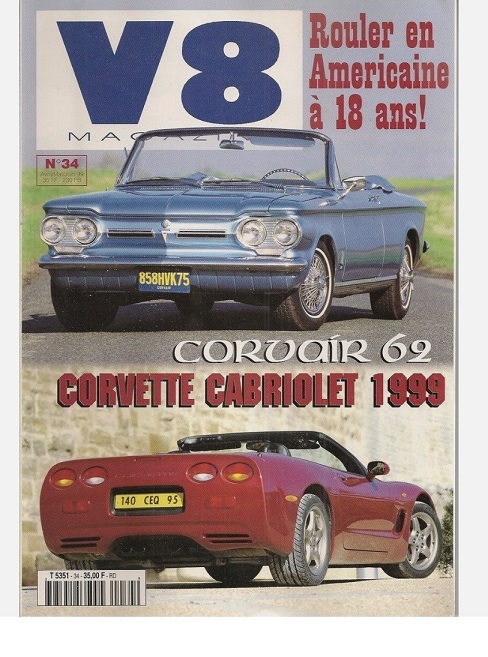
The car he recognized in a French auto magazine "V8" shows the "8X211F10A00001"
serial number.
This number was not widely known, unless you had the car or a copy of the original Ford invoice.
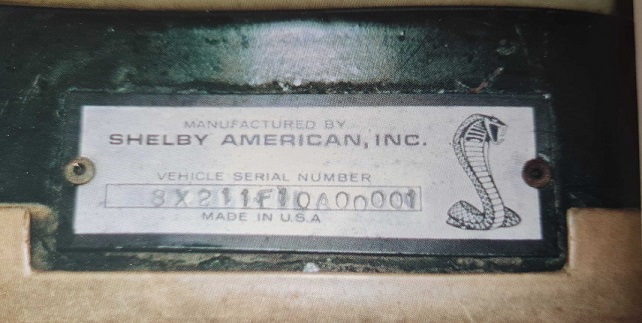
The very unusual tag from the V8 magazine article. I believe this car never received a replacement with the corrected serial number.
This hastilty hand stamped tag maybe original to the car.
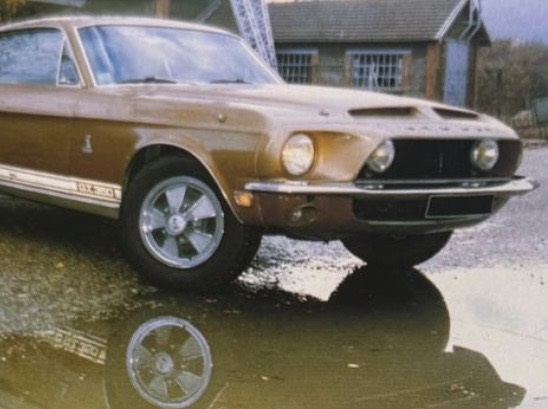
The fender mounted turn signal lights are still evident. Courtesy of V8 magazine.
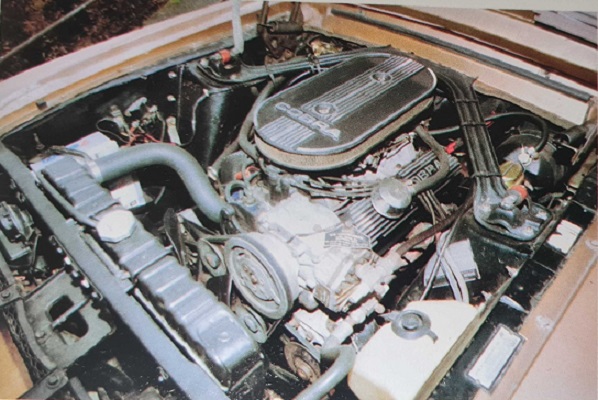
The engine compartment is largely untouched. Courtesy of V8 magazine.
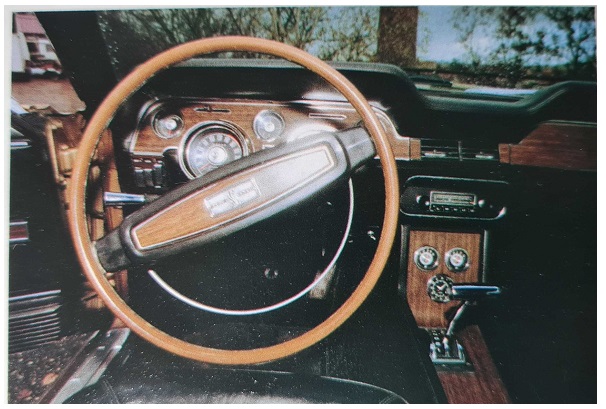
The interior shows a few changes like the addition of a stereo and a clock in the console. Courtesy of V8 magazine.
This magazine was from 1999. There's a high probability the car is still in France. We have made attempts to locate the owner, but so far have been unsucessful.
Our research team has located the photographer and the location of where the pictures were taken. Numerous French Mustang club contacts have
also been made.
When the owner is located we would like to share the unique history of the car and further verify its originality. The first cars built share some
very unique build characteristics that would be very difficult to replicate. We also want the new owner to know they can remain anonymous.
